
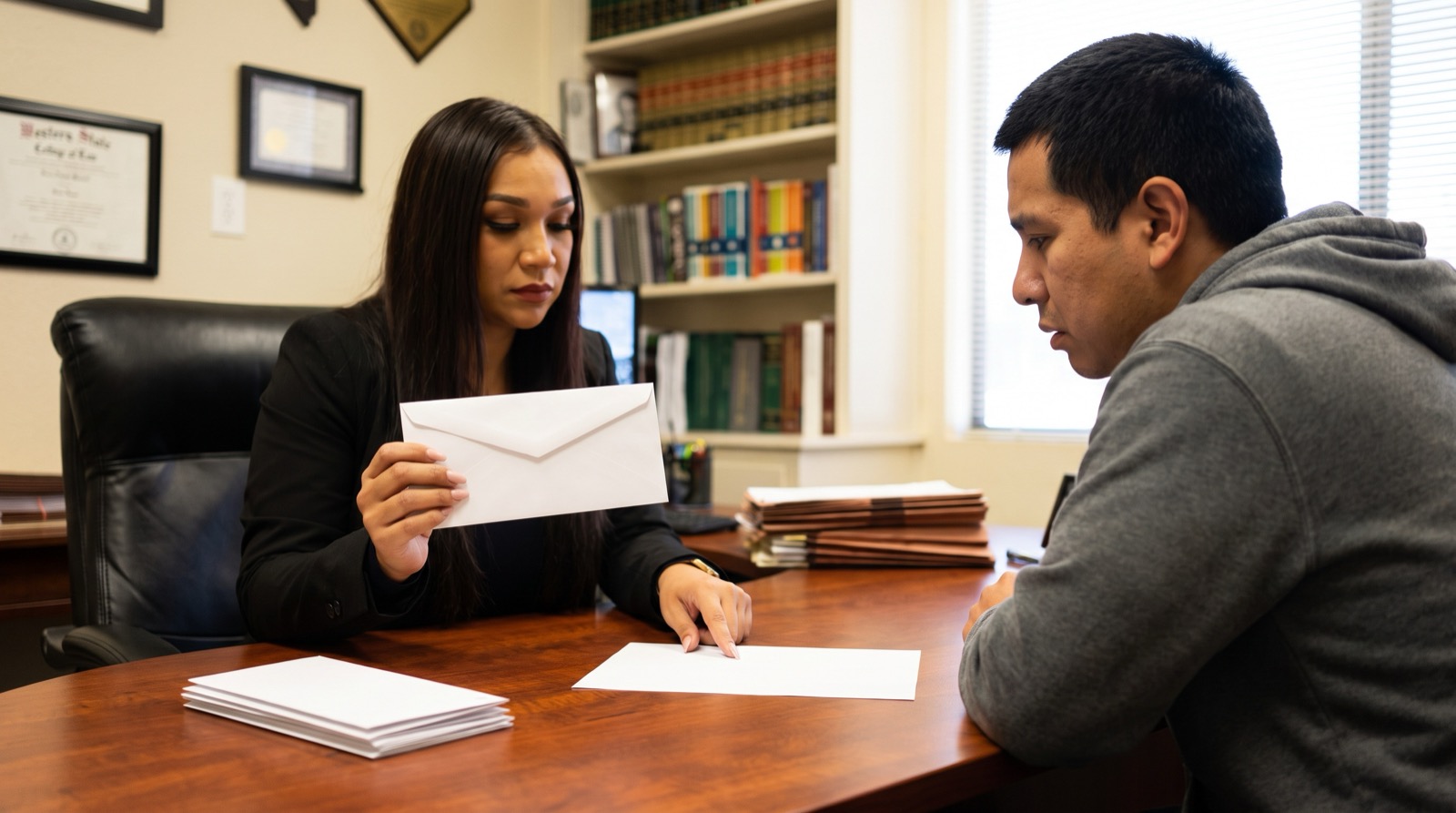
At a glance (120 words): On October 22, 2026, the Board of Immigration Appeals decided Matter of Chamorro Castillo. A man in Washington State missed his hearing because his mailbox was full. The post office held the court’s notice for 10 days, then sent it back as undeliverable. He was ordered deported without being there. The Board held that when a hearing notice mailed to the only address in the record comes back undeliverable, the immigration court owes nothing more: no phone call, no search of government files. The precedent binds every immigration court, including those hearing Nevada cases. The lesson is simple and unforgiving. The court will mail your notice once, to the address you gave. Make sure it arrives.
What Happened in the Case
The facts are ordinary, which is what makes them worth reading.
The Department of Homeland Security filed a Notice to Appear against Mr. Chamorro Castillo on February 22, 2019. Four days later, after releasing him from detention, DHS filed a form with the immigration court listing the address he had reported, on Abert Avenue in Richland, Washington, and a phone number.
On September 9, 2019, the court mailed a hearing notice to that address. It came back in an envelope stamped “RETURN TO SENDER NOT DELIVERABLE AS ADDRESSED UNABLE TO FORWARD.” He did not appear at the January 8, 2020 hearing, and the immigration judge ordered him removed in absentia.
Two months later he filed a motion to reopen on his own, saying he never received the notice. His own documents confirmed the Abert Avenue address was correct. A letter from a postal employee explained what went wrong: his mailbox had filled up, the post office pulled his mail, held it for 10 days, and returned it as unclaimed.
The immigration judge denied the motion. The Board agreed in October 2020. In January 2026 the Ninth Circuit Court of Appeals, which covers Nevada, sent the case back and told the Board to apply a newer Ninth Circuit decision, United States v. Rivera-Valdes, and decide whether the court had any reasonable steps available to reach him once it knew the notice had failed.
What the Board Decided
The Board dismissed the appeal again. Its one-sentence holding:
When mail sent to the only address in the record provided for a respondent is returned as undeliverable, there are no additional reasonably available or practicable steps the Board or an Immigration Court can take to effect notice.
The Board accepted that the Ninth Circuit’s due process standard applies to removal cases. Under that standard, notice must be reasonably calculated to reach you, and if the government learns its notice failed, it has to take additional reasonable steps if any are practicable. The Board’s answer was that for an immigration court, there are none. Its reasons:
- Courts do not investigate. Immigration judges and the Board are neutral adjudicators with no investigators, no budget for it, and crowded dockets. They do not do site visits or online searches to find people.
- No phone calls. Mr. Chamorro Castillo argued the judge could have called the number on file. The Board said no. Calling a party risks improper one-sided contact, and the court cannot reliably confirm who is on the line, which could breach confidentiality rules that protect certain applicants.
- No checking DHS files. The Ninth Circuit had suggested the court could compare the address in the court record against other addresses in the person’s DHS file. The Board said neither judges nor the Board can see that file. It added that DHS should tell the court when it learns of a different address, but it placed no duty on the court to go looking.
- Neutrality. If courts started tracking people down, the Board said, it could look like they were helping DHS carry out arrests and removals.
The Board also noted that the law puts the burden on the parties. You must report any address change to the court on Form EOIR-33, and DHS must report your release address on its own form. The court mails to the address those forms give it.
Why This Matters in Nevada
Nevada is in the Ninth Circuit, and the Ninth Circuit has been more protective on notice than most courts. In Rivera-Valdes (2025), the hearing notice went to an address that was missing the word “Ave.” In Meza Medina v. Blanche (September 18, 2026), the notice went to an address supplied by a third party on a bond form, not the address the person gave the court. In both cases the Ninth Circuit found the government had to do more.
The Board drew a line between those cases and this one. In Chamorro Castillo the court mailed to the correct address, the one the person himself had provided, and there was no other address anywhere in the record. The Board treated the Ninth Circuit cases as wrong-address cases and said they do not help when the address was right and the mail simply came back.
In practice, that means two very different situations:
- The court mailed to the wrong address or an address you never gave. The Ninth Circuit cases are still your strongest argument. Gather proof of what address you actually provided and when.
- The court mailed to the correct address and it bounced. After October 22, 2026, “I never got it” is no longer enough on its own. You would need to show something more, such as a defective address in the record or a change-of-address form the court failed to process.
The Full Mailbox Problem
This case was lost over a full mailbox. That detail should change how you handle mail while you have a case in immigration court.
- Empty your mailbox at least every few days. The post office in this case held the mail for 10 days and then sent it back. Court mail does not get a second attempt.
- Put your name on the mailbox. If you live with others, make sure a carrier can tell your mail belongs there.
- Do not count on forwarding. The returned envelope in this case said “unable to forward.” Filing a forwarding order with the post office is not the same as updating the court. Do both.
- If you travel, arrange for someone to collect your mail or use a USPS hold. A hold is not a fix for a long absence; update your address instead if you will be gone for weeks.
- Open every piece of mail from the government. Hearing notices look like any other official letter.
How to Keep Your Address Current
The regulation, 8 C.F.R. § 1003.15(d), requires you to give the court a written address and telephone number if the Notice to Appear left it blank or got it wrong, and to report every change of address on Form EOIR-33. The court’s instructions say to file within five working days of the change.
- Form EOIR-33/IC goes to the immigration court where your case is pending. If your case is at the Board of Immigration Appeals, use Form EOIR-33/BIA instead.
- You can file it online through EOIR’s Respondent Access portal, or by mail or in person at the court. Keep a copy and proof of the date you filed it.
- One form per person. If several family members have their own cases, each one needs a separate form.
- Tell DHS too. The court form does not update ICE or USCIS. Federal law separately requires most non-citizens to report a move to DHS within 10 days (8 U.S.C. § 1305). If you report to ICE under an order of supervision or ISAP, tell your officer as well.
- Check your hearing date yourself. Look up your case by A-Number at acis.eoir.justice.gov. Do this after any move and every few weeks regardless. The system does not show every case, so a blank result is not proof you have no hearing.
If You Already Have an In Absentia Order
An in absentia order can be rescinded only through a motion to reopen, and the statute, INA § 240(b)(5)(C), allows two paths:
- Within 180 days of the order, if you show the failure to appear was caused by exceptional circumstances beyond your control.
- At any time, if you show you did not receive notice, or you were in federal or state custody and the failure to appear was not your fault.
Filing either motion automatically stays your removal until the immigration judge rules on it.
After Chamorro Castillo, a lack-of-notice motion has to be built on documents, not on a statement that the letter never came. Pull the court file to see exactly what address the notice went to and what came back. Compare it against every address you gave DHS and the court, with dates. Get records from the post office if you can. And note a second Board decision from the same month, Matter of J-E-D-C- (October 19, 2026), which held that judges no longer have to accept the facts in your sworn statement as true when deciding a motion to reopen. Leases, utility bills, postal records, and the forms you actually filed now carry the weight.
Our guide to motions to reopen and reconsider covers the rest of the process, including deadlines for other kinds of motions.
When to Call an Immigration Attorney
The Law Offices of Karen S. Monrreal represents clients in Reno and across Nevada in deportation defense, including motions to reopen in absentia orders. If you moved during your case, if your mail has been returned, or if you have just learned that you were ordered removed at a hearing you did not know about, call (775) 826-2380. For what to do when your case begins, read Notice to Appear: what it means and what happens next.
Frequently Asked Questions
The court sent my notice to my old address after I filed a change of address. Does this decision hurt me?
No. The Board’s holding covers mail sent to the only address in the record. If you filed Form EOIR-33 and the court mailed to the old address anyway, the record contains a newer address and the notice was not reasonably calculated to reach you. Keep your filing receipt; it is your evidence.
I gave my address to ICE when I was released but never to the court. Is that enough?
DHS is supposed to pass your release address to the court on its own form, and in this case it did. Do not rely on that. File Form EOIR-33 yourself so the court record shows the address came from you.
Does the immigration court have to call me if I miss my hearing?
No. The Board held on October 22, 2026 that immigration judges will not call the phone number on file, even when the mailed notice has been returned.
How long do I have to update my address after a move?
The court’s instructions say five working days. Federal law separately requires most non-citizens to report a move to DHS within 10 days.
Is this decision final?
It is a published precedent that binds immigration judges and the Board nationwide as of October 22, 2026. It can be reviewed by a federal court of appeals in a future case. Nevada cases are reviewed by the Ninth Circuit, whose earlier notice decisions the Board distinguished rather than rejected.
Sources: Board of Immigration Appeals, Matter of Chamorro Castillo, 30 I&N Dec. 170 (BIA October 22, 2026), justice.gov; Matter of J-E-D-C-, 30 I&N Dec. 162 (BIA October 19, 2026), justice.gov; United States v. Rivera-Valdes, 157 F.4th 978 (9th Cir. 2025); Meza Medina v. Blanche, Nos. 20-70017, 24-5144 (9th Cir. September 18, 2026), ca9.uscourts.gov; INA § 240(b)(5), 8 U.S.C. § 1229a(b)(5); 8 U.S.C. § 1305; 8 C.F.R. § 1003.15(d); EOIR, “Update Respondent or Alien Information,” justice.gov; EOIR Automated Case Information, acis.eoir.justice.gov.
This article is general information, not legal advice. Whether an in absentia order can be reopened depends on what the court record shows about your address and notice. Speak with an immigration attorney about your own situation.
Questions about your own case?
This guide is general information, not legal advice for your situation. New clients are taken from a waiting list. Call the office to ask about current availability.